A Voorhees NJ film expert reveals what most window film buyers overlook completely
After enough window film consultations in Voorhees Township and the broader Camden County area, certain patterns become unmistakable. The homeowner who selected a film based on price and is calling two years later because the color has shifted. The one who installed solar control film everywhere and is still uncomfortable in the west-facing bedroom because nobody discussed orientation-specific performance. The one who didn’t know their double-pane glass had a Low-E coating and is now facing a voided window warranty and a fogged unit they didn’t budget for.
These are not unusual outcomes. They are the predictable results of specific, consistent gaps in what residential window film buyers know when they make their purchase decisions. The gaps are not the homeowner’s fault — the information is simply not being volunteered clearly enough in most sales conversations. But the cost of the gaps lands on the homeowner regardless of whose fault it is.
Here is what an experienced Voorhees window film specialist sees buyers overlook most consistently — and what changes when those gaps are closed.
Overlooked Factor One: The Difference Between Film Technology Tiers Is Not Cosmetic
The most common misunderstanding in window film purchasing is that film technology differences are primarily about price and aesthetics — that a more expensive film is darker, or looks better, or comes in more options, but delivers roughly similar performance to a budget alternative.
This is not accurate, and the misunderstanding produces the largest category of post-purchase regret in the Voorhees residential market.
The three primary film technology tiers — dyed, metalized, and nano-ceramic — differ not in appearance preferences but in the fundamental mechanism by which they manage solar energy, and this mechanism difference determines how they perform, how long they last, and what they’re compatible with.
Dyed films work by absorbing solar energy into the film’s pigment layer. That absorption converts solar energy to heat within the film itself, which then radiates in both directions — some outward, some back into the room. The net heat reduction is real but limited, and the efficiency of the absorption depends on dye molecules that degrade under sustained UV exposure. In Voorhees’s Camden County climate — where UV index readings between June and August consistently reach 7 to 10 — dyed films accumulate photochemical damage across multiple summer seasons. The visual result is the bronze or purple color shift that tells an experienced eye exactly which film tier was installed and roughly when. The performance result is measurable TSER degradation alongside the color change. A dyed film that starts at 40% TSER may be performing at 30% or below within five to seven years.
Metalized films reject solar energy through reflection rather than absorption. The metallic particles or layers in the film structure bounce infrared radiation away from the glass before it enters the room. This is more efficient than absorption and more UV-stable than dye. But metalized films have specific limitations in Voorhees residential applications: the metallic structure can interfere with WiFi, cellular, and other wireless signals that modern Voorhees homes depend on, and the reflective exterior appearance — a mirrored look on the outside of the glass — may conflict with neighborhood aesthetic norms or HOA guidelines in some Voorhees communities.
Nano-ceramic films achieve their performance through selective wavelength blocking at the molecular level using chemically inert ceramic particles. They do not absorb solar energy into degradable dye molecules. They do not create a reflective exterior appearance. They do not interfere with wireless signals. They maintain their optical clarity and TSER ratings across their full warranty period — typically fifteen years residential — because the material that provides their performance does not degrade under UV exposure. For Voorhees homeowners making a long-term investment in glass performance, nano-ceramic is not a premium option among alternatives. It is the specification that delivers the investment value the purchase is intended to provide.
The gap between what buyers think they’re selecting and what they’re actually getting is widest at the entry level — where a convincing sales conversation can describe a dyed film as “premium” without providing any of the specific metrics that would reveal the difference.
Overlooked Factor Two: Visible Light Transmission Is Not the Same as Comfort
When Voorhees homeowners describe what they want from a solar control film, a consistent phrase appears: “I want something that lets light in but blocks the heat.” This is a precise description of what spectrally selective nano-ceramic films do. It is also a description that sellers of darker, lower-performing tinted films claim for their products — using the same language to describe a fundamentally different result.
The metric that resolves this ambiguity is not TSER alone. It is the combination of Visible Light Transmission — VLT, the percentage of visible light the film allows through — and TSER understood separately.
A film with a VLT of 35% and a TSER of 45% lets in about a third of available visible light while blocking less than half of total solar energy. The room is visibly darker. The thermal improvement is moderate. Many Voorhees homeowners who install this type of film and find the result disappointing describe the room as feeling “dimmer but still warm” — which is precisely what the metrics would predict.
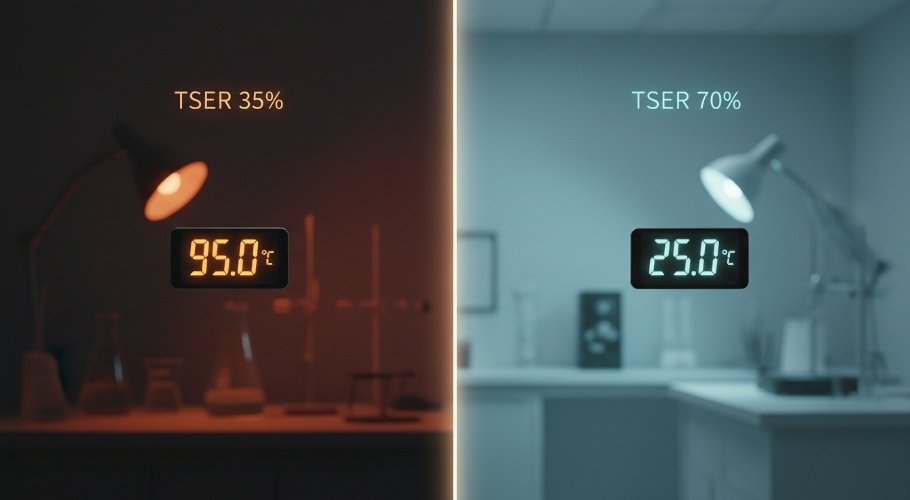
A spectrally selective nano-ceramic film with a VLT of 70% and a TSER of 70% lets in most available visible light while blocking most total solar energy. The room is bright. The thermal improvement is dramatic. This combination — high VLT, high TSER — is what the phrase “lets light in but blocks the heat” actually describes, and it is achievable only through spectrally selective technology, not through darkened tints.
The gap buyers overlook is the assumption that any solar film will deliver this combination if it’s called “solar control.” VLT and TSER should be requested as specific documented numbers for any film being considered — not described in general terms by the seller.
Overlooked Factor Three: The Curing Period Behavior Surprises Almost Everyone
A consistent pattern in Voorhees post-installation calls to window film specialists: a homeowner notices water bubbles, slight haziness, or faint clouding in newly installed film and calls concerned that something went wrong.
Something has not gone wrong. This is normal curing-phase behavior that almost nobody explains clearly at the time of installation.
Professional window film installation uses a wet application method — a solution is applied to the glass, the film is positioned and adhered while wet, and the installer uses a squeegee to remove most of the water from between the film and glass. What cannot be fully removed during installation is a small quantity of residual water vapor distributed throughout the adhesive layer. This vapor is visible as small bubbles, slight cloudiness, or a faint haze that is particularly noticeable in low-angle light.
As the adhesive cures — a process that takes thirty to sixty days in Voorhees conditions, longer in cooler installations and shorter in summer heat — this residual moisture migrates through the adhesive to the film edges and evaporates. The haze and bubbles disappear as curing completes. The film achieves its final optical clarity and full adhesive bond strength.
What buyers overlook is that touching, pressing, or attempting to clean during this period interferes with the curing process in ways that create permanent defects. Pressing on curing-phase bubbles moves water back toward the center of the film. Cleaning with any product during the curing period disrupts the adhesive before it has set. The correct instruction — leave it entirely undisturbed for thirty to sixty days — is simple but frequently not communicated before the installer leaves.
An experienced Voorhees specialist communicates the curing period expectations clearly before finishing the installation, so that the homeowner knows what normal looks like and what to do about it: nothing, for thirty days.
Overlooked Factor Four: Film Does Not Perform Equally on All Four Orientations
Voorhees homeowners who install solar control film and then notice that the improvement in one room is dramatic while another room shows little difference have typically encountered the orientation-performance relationship that nobody explained during their consultation.
Solar control film performs proportionally to the solar load it is intercepting. South-facing glass in a Voorhees home receives direct sun for the longest portion of each day and carries the highest cumulative solar load of any orientation — film on south-facing glass produces the most dramatic, most immediately felt thermal improvement. West-facing glass receives the intense afternoon sun of Camden County summers and produces a similarly dramatic improvement in rooms that previously became uncomfortably warm after noon.
East-facing glass receives morning sun — lower intensity than afternoon exposure but still significant for glare management and UV protection. North-facing glass receives no direct sun at any point during the year in the northern hemisphere. Solar control film on north-facing Voorhees windows produces no thermal improvement because there is no solar thermal load to intercept.
The oversight that produces homeowner disappointment is installing solar control film uniformly throughout a home — including north-facing glass where it adds no solar value — while leaving the most impactful south and west windows as lower priorities due to cost spreading. An experienced Voorhees specialist identifies orientation early in the assessment and prioritizes the installation to maximize the thermal return from the available budget, concentrating the highest-specification films on the highest-solar-load positions and directing appropriate but different specifications to secondary orientations.
Overlooked Factor Five: The Combination Window Is More Common Than Anyone Expects
A specific gap that experienced Voorhees specialists encounter regularly: homeowners who need both solar performance and privacy in the same window position and assume these are mutually exclusive — that solar film comes without privacy and privacy film comes without solar performance.
This assumption misses one of the more practically useful product configurations in the residential film market: solar privacy films that combine meaningful heat rejection with a reflective or slightly tinted exterior surface that provides daytime one-way vision. These films are particularly relevant in Voorhees neighborhoods where homes are positioned close together — where a south-facing living room window both receives significant solar load and directly faces a neighbor’s sightline.
The daytime-only limitation of reflective privacy film is something buyers often overlook as well. Films that provide one-way privacy through a brightness differential — exterior brighter than interior — reverse after dark when interior lighting makes the glass transparent from outside. For Voorhees homeowners whose privacy concern extends into evening hours, frosted or partially frosted film provides complete all-condition privacy while spectrally selective or Low-E films can be layered for performance. Understanding that daytime and nighttime privacy are different problems that may require different solutions is a gap that an experienced local specialist surfaces early in the assessment conversation.
What Changes When the Gaps Are Closed
Closing these five gaps — film technology tier differences, VLT versus thermal comfort, curing period expectations, orientation-specific performance, and combination window solutions — does not require the homeowner to become a window film expert. It requires a consultation where an experienced Voorhees specialist asks the right questions, provides the specific documented metrics rather than marketing descriptions, and takes the time to explain what the homeowner is actually purchasing and why it suits their specific property.
The outcome of that conversation is not just a better purchase. It is a purchase that performs as expected across its full warranty period, that doesn’t produce the calls that experienced Voorhees specialists receive from homeowners whose previous installation fell short of what they believed they were buying.
To get that consultation for your Voorhees Township property — one that closes the gaps before the purchase rather than revealing them afterward — speaking with a local window film specialist who understands Camden County’s housing stock and climate conditions is the most direct path to the result that the investment was intended to produce.