Is Anti-Graffiti Window Film the Right Solution for North Brunswick NJ Properties?
If you own or manage a commercial property along the Route 1 corridor in North Brunswick, the question is less theoretical than it sounds. The township’s rapid mixed-use development — the MainStreet NB project on the former Johnson and Johnson campus, new retail pads, restaurant clusters, and the incoming transit village along the Northeast Corridor rail line — has brought significant foot traffic, vehicle volume, and overnight exposure to storefront glass that simply did not exist five years ago.
Graffiti vandalism follows density. That is not a value judgment — it is an observation with a consistent evidence base. As North Brunswick transitions from a primarily low-density suburban township into an active, walkable commercial corridor, the glass surfaces of ground-floor retail, mixed-use residential lobbies, and service storefronts become routine targets. And the cost of ignoring that reality is not abstract. A single tempered glass storefront panel replacement in a commercial build can run between $800 and $2,500 depending on size and specification — before the labor, the downtime, and the permit paperwork.
Anti-graffiti window film changes that cost equation entirely. The more important question is whether it is the right solution for your specific North Brunswick property — and what the honest limitations are.
What Types of Vandalism Does Anti-Graffiti Film Actually Protect Against in a North Brunswick Context
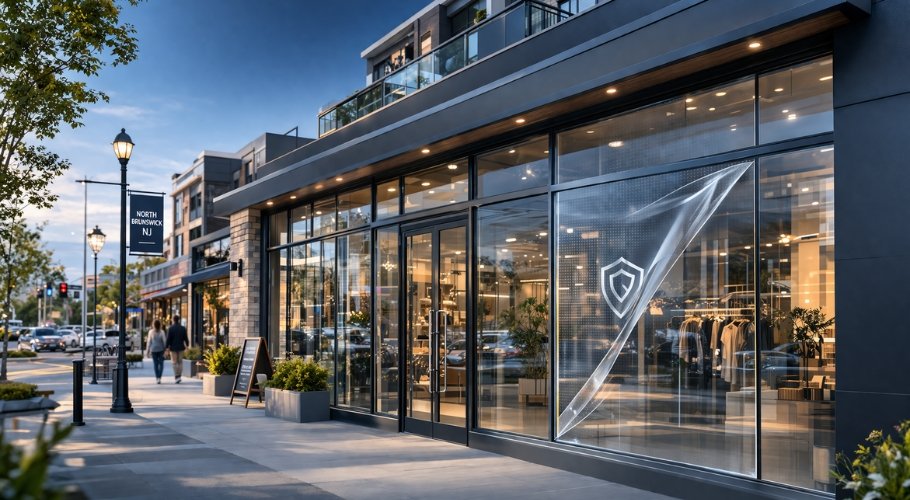
Anti-graffiti film is engineered as a sacrificial exterior layer — a clear polyester laminate applied to the outside surface of glass that takes the damage in place of the glass itself. Understanding what it protects against and what it does not is the starting point for any honest evaluation.
The film handles four categories of surface attack consistently: spray paint, marker and pen tagging, mechanical scratch tagging with keys or sharp instruments, and acid etching. Acid etching is the category that causes permanent, irreversible glass damage and is the primary driver of expensive glass replacement in high-pedestrian commercial environments. A skilled tagger with an etching tool or an acid compound can permanently destroy the optical surface of a glass pane in seconds. Anti-graffiti film absorbs that attack on the exterior film surface — the laminate is etched or scratched, not the glass beneath it. The film is then removed and replaced, and the original glass is undamaged and immediately ready for the next film layer.
In North Brunswick’s emerging commercial zones around Route 1, Finnegans Lane, and the mixed-use residential developments, this protection profile is directly relevant. The combination of new retail visibility, overnight reduced supervision, and transit-accessible access routes creates the conditions under which opportunistic surface vandalism occurs.
How Does the Sacrifice Layer System Work and What Makes It Economically Compelling
The sacrifice layer model is the central value proposition of anti-graffiti film, and it is worth understanding precisely because it inverts the usual cost logic of property maintenance.
Standard glass — whether single-pane storefront, tempered safety glass, or insulated commercial glazing — is essentially unrecoverable once acid-etched or deeply scratched. The damaged surface cannot be polished out. Replacement is the only option, and replacement is expensive, disruptive, and in North Brunswick’s newer commercial construction, often involves matching custom-sized units that require lead time.
Anti-graffiti film operates on a different model. The optically clear polyester laminate — typically 4 mil to 7 mil in thickness — is applied to the exterior glass surface with a quick-release pressure-sensitive adhesive. When the film surface is vandalized, the damage goes into the film. Removing the film takes minutes. The original glass underneath is completely undamaged. A replacement film layer goes on the same day. The glass never requires replacement.
The film transmits 90% of visible light and rejects 97 to 99% of ultraviolet radiation as a structural property of the polyester substrate — meaning storefront product displays, interior signage, and any UV-sensitive merchandise behind the glass are also protected throughout the film’s service life.
Industry cost comparisons are consistent: the cumulative cost of multiple anti-graffiti film removal and replacement cycles — in most commercial applications — reaches the cost of replacing a single panel of affected glass only after many installation cycles, often four to six replacements or more. For a North Brunswick property owner on Route 1 with multiple ground-floor glass surfaces, that economic difference is not marginal. It is the difference between graffiti being a minor recurring maintenance item and a genuine capital expense.
What Does North Brunswick’s Climate Do to Exterior Anti-Graffiti Film Performance
Anti-graffiti film is an exterior-applied product on most commercial installations — it sits on the outside surface of the glass, directly exposed to weather. This makes climate conditions directly relevant to performance and longevity, and North Brunswick’s climate profile creates specific considerations.
North Brunswick carries a humid continental climate with 48 inches of annual rainfall, elevated Atlantic-influenced humidity through summer, and a freeze-thaw cycle through winter. Exterior film adhesive systems are engineered to handle this profile, but performance depends on the quality of the installation surface preparation and edge finishing.
Film applied to glass with existing micro-contamination, silicone residue from prior caulking, or incomplete edge sealing will experience moisture infiltration at the perimeter. In North Brunswick’s wet seasons — which extend from October through early April — that moisture works into the adhesive bond and accelerates edge lift. Proper surface preparation before installation and clean edge finishing on every panel are not optional steps; in this climate, they are the primary determinants of whether the film performs as designed or requires premature replacement.
The freeze-thaw cycle also stresses exterior adhesive bonds at the film perimeter. For North Brunswick commercial properties with aluminum-framed storefronts — the standard in most Route 1 retail construction — the expansion and contraction of the frame through winter temperature swings places mechanical stress on the adhesive edge. Premium-grade anti-graffiti films with flexible adhesive systems handle this better than entry-level films, and the cost difference at installation is meaningfully lower than the cost of premature replacement.
What Are the Practical Differences Between 4 Mil and 7 Mil Anti-Graffiti Film for North Brunswick Properties
Both 4 mil and 7 mil anti-graffiti films operate on the same sacrifice layer principle, but they are not interchangeable in every application.
4 mil anti-graffiti film is the standard commercial specification for most storefront and mixed-use property applications. It provides full protection against spray paint, marker tagging, and standard scratch attacks. It transmits 90% or more of visible light, installs with a low visible profile, and removes cleanly without adhesive residue. For the majority of North Brunswick retail and commercial glass applications — storefronts, lobby glazing, restaurant windows, transit-adjacent glass panels — 4 mil film delivers the protection needed at the most practical installation and replacement cost point.
7 mil anti-graffiti film offers increased substrate thickness that provides meaningful additional resistance against deeper mechanical scratch attacks and more aggressive etching tool use. It is the appropriate specification for locations where the risk profile is higher — restroom mirror surfaces, elevator interior glass panels, transit platform glazing, and any glass surface in a confined or low-visibility area where extended-duration etching attacks are more likely. As North Brunswick’s MainStreet NB transit village matures and the planned train station comes online, these specifications become directly relevant for any commercial tenant with glass in semi-enclosed or platform-adjacent environments.
The decision between 4 mil and 7 mil is primarily a risk-assessment decision, not a budget decision. Both are significantly less expensive than glass replacement. The right choice depends on where the glass is, how it is accessed, and what type of vandalism has historically occurred in similar locations nearby.
When Is Anti-Graffiti Film the Right Investment and When Is Something Else Needed
Anti-graffiti film is the right solution when the primary risk to a North Brunswick property’s glass is surface vandalism — spray paint, marker tagging, scratch attacks, and acid etching. For that specific threat category, it outperforms every alternative on cost, recovery speed, and preservation of the original glass.
It is not a security film. It does not provide meaningful impact resistance against forced entry, does not hold shattered glass fragments in place, and does not function as a structural barrier against smash-and-grab attempts. Properties in North Brunswick where forced entry through glass is a concern require security laminate — typically 8 mil or thicker interior-applied film — which is a separate product with a separate function.
For North Brunswick commercial property owners and managers assessing their glass for the first time, the practical first step is a perimeter assessment that distinguishes between the surfaces most at risk for surface vandalism — ground-floor exterior glass in high-pedestrian-traffic zones — and those most at risk for forced entry. In many Route 1 commercial properties, both types of glass exist, and the solution is not one product but two, applied to the right surfaces. A window film specialist familiar with Middlesex County commercial properties can conduct that assessment and provide a specification matched to the actual risk profile of the building.
FAQ
Does anti-graffiti film prevent spray paint and acid etching from reaching the glass?
Yes — the film absorbs the attack so the original glass underneath stays completely undamaged.
How quickly can anti-graffiti film be removed and replaced after a vandalism incident?
Professional removal and replacement of a standard storefront panel takes under an hour.
Is anti-graffiti film visible from outside a North Brunswick retail storefront?
No — optically clear film transmits 90% of visible light and is effectively invisible once installed.
Does North Brunswick’s wet climate affect how long exterior anti-graffiti film lasts?
Yes — proper edge sealing during installation prevents moisture-driven adhesive failure here.
Can anti-graffiti film also protect against forced entry through storefront glass?
No — forced entry protection requires a separate interior-applied security laminate product.