Window film in Moorestown, NJ, lasts longer when you follow these simple steps
There is a particular satisfaction that comes with a well-executed home improvement in Moorestown. The project is done, the result is visible, and the investment is made. For window film, that moment arrives when the installer packs up, the glass looks clean and clear, and the room already feels noticeably more comfortable than it did the morning before.
What most homeowners don’t fully appreciate at that point is that a decision made in the next thirty days — and habits formed in the months that follow — will determine whether the investment they’ve just made performs for twelve years or twenty-two. Not the film specification. Not the installation quality. Their own post-installation behavior.
Premium window film is remarkably durable when treated correctly. The same nano-ceramic film that carries a fifteen-year manufacturer warranty can, with straightforward care, perform at original specification well past that point in Moorestown’s climate. And the same premium film, subjected to even occasional mishandling, can develop defects that void warranty coverage and accelerate degradation long before its material lifespan is reached.
The steps that protect a Moorestown window film investment are not demanding. They are simply specific — and most homeowners aren’t told them clearly enough at the time of installation.
Step One: Respect the Curing Period
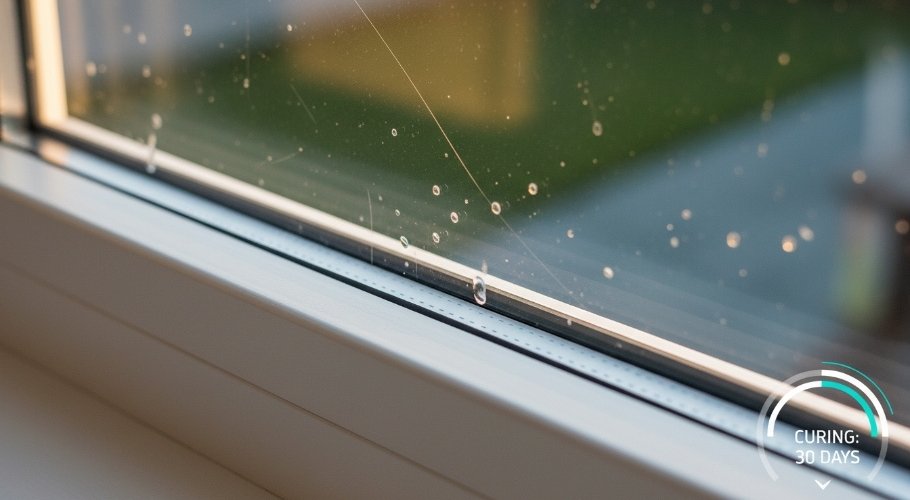
The most consequential post-installation period for any window film is the first thirty to sixty days. This is the curing window — the period during which the pressure-sensitive adhesive that bonds the film to the glass is completing its molecular-level cure and achieving its designed adhesion strength.
During this period, the adhesive is not yet at full bond strength. Micro-pockets of water vapor that are a normal part of the installation process — introduced during the wet application method used by professional installers — are slowly migrating through the adhesive to the film edges and evaporating. It is entirely normal for newly installed film in a Moorestown home to show small water bubbles, slight haziness, or faint clouding in the first two to four weeks. These are curing artifacts, not defects, and they resolve on their own as the adhesive completes its cure.
What causes lasting damage during this period is mechanical interference with the curing process. Pressing on bubbles to move water toward the edges, attempting to squeegee out remaining moisture, peeling back film edges to “check” adhesion, or cleaning the surface before the curing period is complete — all of these actions interrupt the adhesive cure and can create permanent bubbles, adhesion failures, or edge lifting that will not resolve and that may or may not be covered under warranty depending on how the damage occurred.
The correct approach during the curing period in a Moorestown home is to leave the film entirely undisturbed. Do not clean it. Do not touch the surface. Do not attempt to accelerate the curing process with heat guns or fans. Moorestown’s summer installations — typically completed from April through September in South Jersey’s climate — cure faster than winter installations because warmer temperatures accelerate the adhesive cure. A film installed in July may be fully cured in three weeks. A film installed in December in a Moorestown home may take the full sixty days. Patience during this period is the single most protective thing a homeowner can do.
Step Two: Use Only Film-Safe Cleaning Products
This is the maintenance failure that accounts for the majority of warranty claims denied in residential window film installations — and it is entirely preventable.
Standard residential glass cleaning products — ammonia-based solutions that are effective on bare glass — are incompatible with window film. Ammonia at the concentrations present in common glass cleaners chemically attacks the film’s adhesive layer and surface coating, causing permanent damage that manifests as hazing, delamination, and surface cloudiness. This damage is not reversible. It voids manufacturer warranty coverage. And it is exactly the kind of cleaning product that Moorestown homeowners with film-free windows elsewhere in the home are likely to keep under the kitchen sink and deploy throughout the house without distinguishing between treated and untreated glass.
The film-safe cleaning standard is straightforward: mild dish soap or a purpose-formulated film cleaning solution diluted in clean water, applied with a soft microfiber cloth, soft synthetic sponge, or a clean soft rubber squeegee. The material surface should be soft enough that it cannot abrade the film. The cleaning solution should be free of ammonia, alcohol at high concentrations, and any solvent-based ingredient.
Practical implementation in Moorestown homes where some windows are filmed and others are not requires either a single standard for all windows — film-safe cleaning products throughout — or a clear labeling or organizational system that prevents the ammonia cleaner from being used on filmed glass. Most Moorestown homeowners who have experienced post-installation film damage from cleaning products report that the incident happened during a routine cleaning session where the cleaner in hand was used on filmed windows out of habit rather than intent.
The simplest solution is the most reliable: make the film-safe cleaner the household standard and retire the ammonia-based products. The mild soapy solution that protects the film is equally effective on non-filmed glass surfaces.
Step Three: Use Soft Tools Exclusively
The film surface is a precision optical coating, not bare glass. It responds differently to cleaning tools than the substrate beneath it does.
Hard scrapers, abrasive scrubbing pads, steel wool, and coarse cloths will scratch film surfaces. Even scratches that are too fine to see clearly in normal light create a cumulative haziness across the film that becomes progressively more visible as the scratches multiply. Film surface scratches are not covered under manufacturer warranty — they are classified as physical damage — and they cannot be polished out the way some optical surfaces can. A scratched film must be replaced entirely to restore optical clarity.
In Moorestown homes where exterior window cleaning services are used, this is a specific risk point. Professional window cleaners who are not informed that interior film is present may use their standard tools — hard squeegees, abrasive pads, solvents — on the glass surface. If that cleaning contact passes through to an interior-applied film, surface damage results. Informing your window cleaning service about interior film and confirming they will use appropriate materials — and cleaning only from the exterior for exterior dirt — is a simple communication that protects the film.
For interior cleaning of filmed windows in Moorestown, the tool sequence is: soft microfiber cloth or clean soft sponge for the cleaning pass, followed optionally by a clean soft rubber squeegee for finishing. Nothing harder, nothing abrasive, nothing with chemical incompatibility.
Step Four: Protect Film Edges From Moisture Intrusion
Film edges — where the film terminates at the glass perimeter — are the most structurally vulnerable section of a window film installation. Edge lifting, if it begins, tends to propagate inward over time. Moisture intrusion at film edges accelerates this process by working under the adhesive bond from the perimeter inward.
In Moorestown’s climate, the conditions most likely to introduce edge moisture are spring and autumn humidity — when extended periods of elevated relative humidity coincide with significant temperature swings — and condensation that forms at window edges during winter cold snaps. Both scenarios create moisture conditions at the glass perimeter that, over multiple cycles, can begin to compromise edge adhesion if the original edge sealing was less than complete.
There is no active maintenance step for edges beyond avoiding practices that introduce moisture. Avoid directing spray cleaners at window frame edges where film terminates. In Moorestown bathrooms and kitchens where steam and moisture are part of normal room function, ensure adequate ventilation to prevent persistent elevated humidity at filmed glass surfaces. And if edge lifting is observed — even at an early, small scale — address it promptly rather than waiting. Small edge lifts can often be resealed by a professional installer before they propagate; large-scale edge delamination typically requires re-installation.
Step Five: Perform Seasonal Visual Inspections
Window film does not require active maintenance between cleaning sessions — it performs passively and continuously without any homeowner intervention. But a brief seasonal visual inspection — once in spring, once in autumn — allows Moorestown homeowners to identify developing issues early enough that they can be addressed under warranty or with minor professional intervention rather than requiring full replacement.
What to look for: edge lifting at any point around the glass perimeter, bubbles that have appeared since the curing period ended (unlike curing-phase bubbles, post-cure bubbles are defects), visible discoloration or color shift that was not present previously, and any areas of haziness or delamination.
Moorestown’s spring inspection is particularly important because it follows the conditions — freeze-thaw cycling, elevated humidity, and temperature swings — most likely to stress edge adhesion and adhesive bonds. Issues that develop through winter often become visible in late March or April. Catching them at this point gives warranty coverage the most time to apply if a manufacturer defect claim is appropriate.
The autumn inspection serves the same purpose in reverse — it follows the summer UV load season, when film material degradation accumulates fastest. Optical changes that develop across the summer may be subtle enough that they’re not noticed in daily use but visible when looking specifically for them in a seasonal assessment.
Step Six: Protect Film During Renovation and Adjacent Work
Moorestown homeowners who undertake home renovations are the most common source of non-warranted film damage, and the mechanism is consistently the same: renovation work near filmed windows introduces chemical or mechanical hazards that the film warranty explicitly excludes.
Paint and primer overspray near windows — particularly solvent-based paints — can chemically attack film surfaces or adhesive edges if contact occurs. Caulk application or removal near window frames can involve solvents or mechanical scraping that contacts film edges. Sandpaper or abrasive contact from adjacent surface preparation work can scratch film directly.
The protective measure is straightforward: before any renovation work in a room with filmed windows begins, tape clean plastic sheeting over the filmed glass to protect it from spray, chemical contact, and accidental abrasion. This adds minimal time to renovation preparation and removes the film damage risk entirely. Remove the protective sheeting carefully after the renovation work is complete — without using solvents or adhesive tape directly on the film surface — and inspect for any contact that may have occurred despite the protection.
Communicating to renovation contractors that filmed windows are present and need to be protected is a simple step that most Moorestown homeowners skip because they don’t think to make the connection until after something goes wrong.
The Investment Logic Behind These Steps
A premium nano-ceramic film installation on Moorestown’s double-pane windows — with a fifteen-year manufacturer warranty — represents a meaningful investment in energy performance, UV protection, and comfort. The steps above require no special materials, no regular professional visits, and minimal time. The protective value they provide is disproportionately large relative to the effort involved.
The homeowners in Moorestown whose window film looks and performs like new fifteen years after installation are, almost without exception, not the ones with the highest-quality film. They are the ones who used the right cleaner consistently, respected the curing period, protected edges from moisture, and addressed small issues promptly before they became large ones.
To ensure that your Moorestown window film installation is set up for maximum longevity — with the right product, the right installation, and a clear understanding of what protects it over Burlington County’s full four-season climate — speaking with a local window film specialist who knows the township’s specific housing conditions is the most direct path to getting the full value from every year of that investment.