How Long Does Anti-Microbial Window Film Actually Last in South Brunswick NJ Homes?
Most South Brunswick homeowners asking this question already understand why they installed the film. The surfaces around windows and glass doors are high-contact, high-humidity zones — exactly the environment where microbial growth gets a foothold and stays there. The anti-microbial film went on, and the protection kicked in. What nobody explains clearly enough upfront is what happens to that protection over time, and whether South Brunswick’s particular climate conditions are quietly working against the investment.
The honest answer is more nuanced than a single number. Anti-microbial window film has two distinct performance timelines running simultaneously — the active antimicrobial protection layer and the underlying film substrate — and in South Brunswick’s humid continental environment, both are influenced by conditions that most homeowners never account for.
What Does South Brunswick’s Climate Actually Do to Window Film Over Time
South Brunswick Township sits in Middlesex County, in the Raritan Valley corridor between New Brunswick and Princeton. It carries a humid continental climate classification, with 206 sunny days per year, annual rainfall averaging 48 inches — meaningfully above the national average of 38 inches — and humidity levels elevated year-round by proximity to the Atlantic coast.
This combination creates a specific stress profile for any film installed on interior or exterior glass surfaces. Summer in South Brunswick brings peak temperatures regularly reaching the low-to-mid 90s Fahrenheit, with corresponding solar irradiance that drives thermal cycling through south- and west-facing window glass. Winter drops the average to approximately 35 degrees Fahrenheit, with freeze-thaw cycles that expand and contract window frame materials, placing mechanical stress on the adhesive bond at the film’s perimeter edges.
The 48-inch annual rainfall figure matters because moisture infiltration along the film edge is one of the primary accelerants of adhesive bond degradation. In South Brunswick homes where older window frames carry micro-gaps between the frame and glazing, ambient moisture works into those gaps and undermines the edge seal of improperly installed film over time. This is not a reason to avoid the product — it is a reason to understand what installation quality and maintenance practices actually control.
How Does Anti-Microbial Film Technology Work and What Determines Its Active Life
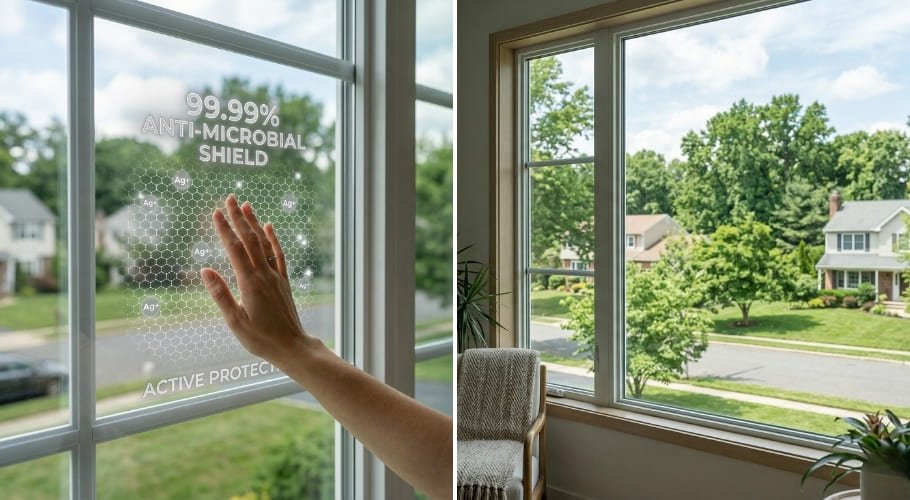
Anti-microbial window film operates through silver-ion technology embedded in or applied to the film’s surface layer during manufacturing. When microbes — bacteria, fungi, certain viruses — make contact with the treated surface, the released silver ions disrupt the microorganism’s metabolic mechanism at a cellular level. The ion contact damages essential proteins, interrupts energy production, and prevents cell replication. The result is a 99.99% reduction in bacterial activity on the treated surface, measured against organisms including MRSA, Salmonella, Listeria, and E. coli under ISO 22196 test standards.
The critical distinction between anti-microbial film and topical surface disinfectants is persistence. A spray disinfectant is active until it evaporates or is wiped away. Silver-ion film is active continuously — every hour of every day — without reapplication, without activation, and without behavioral change from the homeowner. The technology works because the silver reservoir in the film’s surface layer releases ions passively and consistently whenever microbial contact occurs.
The active antimicrobial lifespan of silver-ion film under standard conditions runs approximately five years of continuous protection at clinical performance levels. This is the period over which the silver concentration in the surface layer remains sufficient to deliver the 99.99% bacterial reduction rate verified by independent laboratory testing. After five years, antimicrobial activity does not switch off abruptly — it tapers as the silver reservoir diminishes — but the film can no longer be relied upon to deliver consistent performance at the verified standard.
What Is the Lifespan of the Underlying Film Substrate in a South Brunswick Home
The antimicrobial protection layer and the polyester film substrate it sits on have entirely different lifespans, and understanding the distinction matters for budgeting and planning.
The base polyester laminate in most professional-grade anti-microbial film constructions — typically a 4 mil high-tensile strength PET substrate — carries a structural lifespan of 10 to 20 years under normal residential conditions. The film itself, separate from its antimicrobial properties, provides UV blocking, surface protection, scratch resistance, and optical clarity throughout that full period.
In South Brunswick specifically, two climate-driven factors affect where a given installation lands within that 10-to-20-year range. First, UV exposure: with 206 sunny days annually, south-facing windows receive cumulative ultraviolet loading that accelerates color shift and adhesive breakdown in lower-quality films. Premium films with UV-resistant adhesive systems maintain structural integrity throughout their rated lifespan despite this exposure. Second, humidity: high ambient moisture accelerates edge seal degradation in installations where the film edge is left unsealed or where the window frame carries pre-existing micro-gaps. Proper edge finishing during installation — sealing the film perimeter with appropriate materials — is the primary protective measure against moisture-driven early failure in South Brunswick’s climate.
South Brunswick homes in communities like Kendall Park, Monmouth Junction, and the residential developments around Route 27 often feature vinyl-framed windows installed in the 1990s and early 2000s. These frames, while generally sound, develop micro-seal gaps as the vinyl ages through repeated thermal cycling. Identifying these gaps before film installation and addressing them at the frame level protects the adhesive bond throughout the film’s full intended service life.
How Do You Extend Anti-Microbial Film Performance in a High-Humidity Environment
The difference between a film that performs well for five years and one that begins showing edge lift, hazing, or reduced antimicrobial activity at three years almost always traces back to installation quality and post-installation care — not to the product itself.
Installation standard matters more than product grade. Anti-microbial film applied without proper edge finishing in South Brunswick’s moisture environment will experience adhesive creep from the perimeter inward over time. Professional installation includes trimming film edges cleanly to within 1/16 inch of the frame edge and applying appropriate edge sealant on windows in high-humidity zones — bathrooms, kitchens, and any room adjacent to the home’s exterior in wet seasons.
Cleaning method affects the silver-ion surface layer. The silver technology in the film’s coating is embedded during manufacturing and is not a topical spray. However, repeated cleaning with harsh solvents or abrasive materials degrades the surface layer faster than ambient use alone. Standard cleaning with a soft cloth and mild diluted cleaner — no ammonia, no abrasives — preserves the surface coating integrity throughout the five-year active antimicrobial period.
Replacement planning is part of the value model. Because anti-microbial film is designed as a removable, replaceable product — with pressure-sensitive adhesive that releases cleanly without glass damage — the intended service model is periodic replacement of the antimicrobial surface layer while the underlying glass and frame remain undisturbed. For South Brunswick homeowners, building a five-year replacement cycle into the investment calculation, with the knowledge that the substrate may outlast two or three antimicrobial refresh cycles, provides the most accurate picture of long-term cost.
When Does Replacing Anti-Microbial Film Become the Right Decision for a South Brunswick Home
The five-year active antimicrobial lifespan provides the clearest replacement trigger. But South Brunswick’s climate adds two earlier indicators that homeowners should watch for regardless of calendar timeline.
Edge lift — visible separation between the film edge and the window frame — indicates that moisture has reached the adhesive layer. Once edge lift begins, it progresses. A film showing edge lift is no longer performing as a sealed surface barrier and should be assessed for replacement promptly, particularly in high-contact zones like entry sidelights, kitchen windows, and bathroom glazing where the antimicrobial function is most relevant.
Surface hazing or visible cloudiness indicates UV-driven adhesive breakdown or adhesive contamination from cleaning products. Haze that was not present at installation and cannot be removed with gentle cleaning is a signal that the optical and structural performance of the film has degraded. At that point, replacement rather than maintenance is the appropriate response.
For South Brunswick homeowners approaching or past the five-year mark on their installation, or noticing either of these indicators, consulting with a window film specialist to assess the current installation before planning the next one ensures the replacement is timed correctly and that the new film goes onto a properly prepared surface. That assessment makes the next five-year cycle perform as well as the first.
FAQ
How long does the active anti-microbial protection in silver-ion window film last?
Anti-microbial silver-ion film maintains verified 99.99% bacterial reduction for approximately five years.
Does South Brunswick’s high humidity shorten window film lifespan?
Yes — edge sealing during installation is essential to prevent moisture-driven adhesive failure here.
Can anti-microbial window film be removed and replaced without damaging the glass?
Yes — pressure-sensitive adhesive releases cleanly, making periodic replacement straightforward.
What cleaning products are safe to use on anti-microbial window film surfaces?
Use a soft cloth with mild diluted soap — no ammonia, no abrasives, no solvent-based cleaners.
How do I know when my anti-microbial film needs to be replaced in my South Brunswick home?
Edge lift, surface hazing, or passing the five-year mark are the three key replacement indicators.