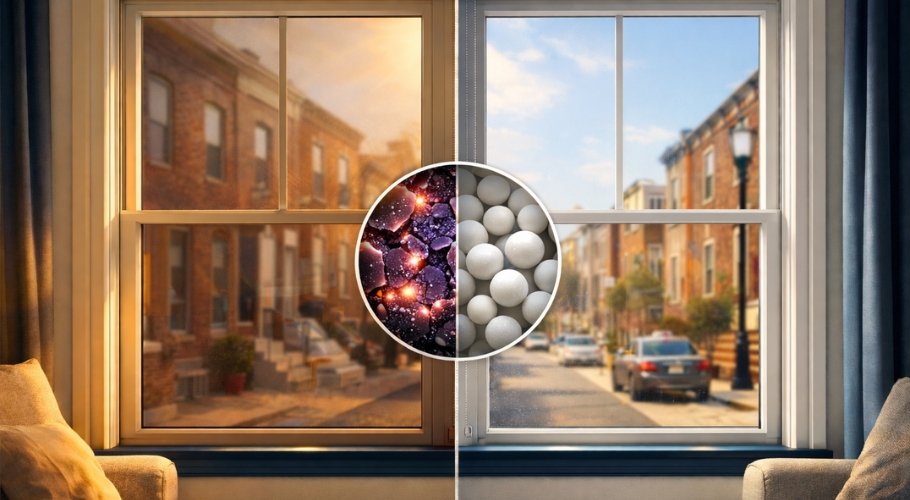
Why Do Philadelphia PA Homeowners Struggle to Choose Between Ceramic and Solar Film
Philadelphia is not a forgiving city for unprotected glass. Row homes in South Philly absorb afternoon sun directly through west-facing facades with windows that have nowhere to hide. Newer construction in Fishtown and Northern Liberties features floor-to-ceiling glass that looks stunning in a listing photo and becomes a liability by July. Historic homes in Chestnut Hill and Germantown carry single-pane original windows that transmit virtually every BTU the sun delivers.
When a Philadelphia homeowner starts researching window film, two terms appear immediately and almost interchangeably — ceramic film and solar film. They are not the same product. They are not even the same product category in every case. And choosing the wrong one for a Philadelphia home means spending money on a film that either underperforms in the city’s intense summer conditions, degrades faster than it should, or creates compatibility problems with existing glass that cost significantly more to fix than the film itself.
This guide breaks both down side by side — what each is, how each performs in Philadelphia’s specific climate, and which one genuinely fits your property.
How Does Philadelphia’s Climate Determine Which Film Type a Home Actually Needs
Philadelphia sits in a humid subtropical transition zone — hot, humid summers with genuine solar intensity, and cold winters that make thermal management a year-round concern rather than a seasonal one. July average highs in Philadelphia reach 88°F to 90°F with heat index values regularly exceeding 95°F during peak afternoon hours. UV index readings between June and August consistently range from 7 to 10 — high to very high — and the city’s dense urban fabric means that south- and west-facing glass on Philadelphia row homes absorbs solar radiation with almost no natural shading relief.
What this climate profile demands from a window film is specific. It needs genuine heat rejection — not cosmetic tinting that darkens the glass without meaningfully reducing thermal load. It needs UV stability, because a film that degrades under Philadelphia’s sustained summer UV load will need replacing long before its stated lifespan. And it needs compatibility with the wide range of glass types present across Philadelphia’s housing stock — from original single-pane glass in the city’s older neighborhoods to modern double-pane Low-E units in newer construction near Center City and the Delaware waterfront corridor.
The distinction between ceramic film and solar film matters most precisely because Philadelphia’s climate is demanding enough that the performance gap between film tiers is felt immediately and consistently — not just on the worst days of August.
What Is the Scientific Difference Between How Ceramic Film and Solar Film Actually Work
Solar film is a broad category term. It describes any film engineered to manage solar energy passing through glass — which technically includes dyed films, metalized films, and ceramic films. When a Philadelphia homeowner sees solar film in a product description, it does not automatically mean high performance. It means the film has some solar management function. The tier within that category determines the actual performance.
Ceramic film is a specific technology within the solar film category. It uses microscopic non-metallic ceramic particles embedded in the film’s polyester base to achieve heat rejection through selective wavelength blocking rather than through absorption or bulk reflection. This distinction in mechanism produces three important differences in Philadelphia applications.
First, ceramic particles are chemically inert and UV-stable. They do not degrade photochemically under sustained UV exposure the way dye molecules in entry-level solar films do. A dyed solar film installed on a south-facing Philadelphia row home absorbs UV energy into its pigment layer throughout every summer — and those pigments break down over five to eight years, producing the bronze or purple color shift that tells an experienced eye exactly what tier of film was installed and approximately when. A ceramic film’s particles do not react to UV exposure. The film that goes on in year one looks and performs the same in year fifteen.
Second, ceramic films achieve heat rejection without the metallic reflectivity that gives some solar films a mirrored exterior appearance. For Philadelphia’s historically sensitive neighborhoods — Rittenhouse Square, Society Hill, Old City — where exterior appearance matters both aesthetically and in some cases from a preservation standpoint, a neutral-appearance ceramic film is the only specification that delivers high performance without changing how the building reads from the street.
Third, ceramic films do not interfere with wireless signals. Philadelphia’s row homes and newer construction are full of smart home systems, mesh WiFi networks, and cellular-dependent devices. Metalized solar films can attenuate these signals measurably. Ceramic films do not — which matters practically for any Philadelphia homeowner whose home office, security system, or daily workflow depends on reliable wireless connectivity.
How Do the Performance Numbers of Ceramic and Standard Solar Film Compare Side by Side
The metric that most directly predicts how much difference a film will make in a Philadelphia home is Total Solar Energy Rejected — TSER. This single figure represents the percentage of the sun’s combined energy — infrared heat, visible light, and ultraviolet radiation — that the film prevents from entering through the glass.
Entry-level dyed solar films typically deliver TSER ratings of 25% to 40%. They make a noticeable but modest difference on a direct-sun Philadelphia afternoon. The room is somewhat less warm. The glare is somewhat reduced. But the fundamental thermal load problem remains largely present.
Mid-tier metalized solar films reach TSER ratings of 45% to 60%. This is a meaningful performance step that produces genuine improvement in Philadelphia summer conditions. The trade-off is the reflective exterior appearance and potential signal interference already described.
Premium ceramic films achieve TSER ratings of 65% to 80%. At 70% TSER on a south-facing Philadelphia row home window, the film is blocking nearly three-quarters of the sun’s total solar energy before it enters the room. The thermal difference between a room with 70% TSER ceramic film and the same room with 35% TSER dyed film is not subtle — it is the difference between a room that remains comfortable throughout a July afternoon and one that remains stubbornly warm despite the film being present.
UV blocking across all quality film tiers reaches 99% or above. Glare reduction on premium ceramic films reaches 60% to 80% — directly relevant for Philadelphia homeowners dealing with screen glare in home offices or south-facing living rooms where afternoon sun makes televisions unwatchable.
Which Philadelphia Homes and Glass Types Are Best Matched to Ceramic Film
Understanding where ceramic film delivers its greatest return helps Philadelphia homeowners prioritise their installation investment correctly rather than applying a uniform specification to every window regardless of conditions.
Row homes in South Philadelphia, Fishtown, and Northern Liberties with west-facing glass represent the highest-priority ceramic film application in the city. These properties absorb direct afternoon sun with no setback, no shade trees, and no architectural relief. The sustained west-facing solar load from 1 PM through sunset during Philadelphia’s five-month cooling season creates exactly the conditions where the performance gap between ceramic and entry-level solar film is felt daily.
Double-pane windows in newer Philadelphia construction require ceramic film specifically because of glass compatibility. High-absorption dyed solar films raise the temperature of the outer pane of a double-pane unit, creating thermal stress in the sealed air gap that progressively damages the seal over three to seven years. Ceramic films achieve their performance through wavelength-selective blocking rather than absorption — producing minimal additional pane temperature rise and making them the safe specification for any Philadelphia home with sealed insulated glass units.
Historic homes in Chestnut Hill, Germantown, and Society Hill with original single-pane glass benefit from ceramic film’s neutral appearance — maintaining the visual character of period windows from the street while delivering full solar control performance from inside. For these properties, the UV protection component is particularly valuable for preserving original woodwork, period floors, and historic interiors that have no equivalent replacement value.
Home offices and screen-intensive rooms throughout Philadelphia benefit from ceramic film’s glare reduction without signal interference — addressing both the visual comfort problem and preserving the wireless performance that remote work environments depend on.
Is Ceramic Film Worth the Higher Investment for a Philadelphia Home Over Standard Solar Film
The cost difference between entry-level solar film and premium ceramic film is real — ceramic film carries a higher material cost that reflects its engineering sophistication and performance longevity. The question every Philadelphia homeowner should answer before selecting a film is whether that premium is justified by the specific conditions their windows experience.
For Philadelphia’s south- and west-facing glass across the summer heat corridor from May through September, the answer is consistently yes. A 35% TSER dyed solar film that costs less upfront but degrades to 25% TSER within five years — while the room it was supposed to cool remains uncomfortably warm — is not a saving. It is a delayed expense with five years of underperformance built into the interim. A 70% TSER ceramic film that maintains that performance across fifteen to twenty years delivers its return continuously across every Philadelphia summer for the duration of its warranty.
The compatibility dimension compounds this further. A dyed film installed on Philadelphia double-pane glass that causes a seal failure in year four costs $250 to $500 per window in glass unit replacement — on top of the original film installation cost. The ceramic film that was compatible from day one never generates that replacement expense.
For Philadelphia homeowners with north-facing glass or heavily shaded windows where solar load is genuinely low, the premium of ceramic film over a quality mid-tier solar film narrows meaningfully. Understanding which windows in your specific Philadelphia property carry the solar load that justifies ceramic specification is the conversation worth having with a local specialist before committing to a whole-home installation.
FAQ
Does ceramic film look different from standard solar film once installed on Philadelphia windows?
No — premium ceramic film maintains a neutral, clear appearance with no visible tint or mirror effect.
Will ceramic film work on the double-pane windows common in newer Philadelphia construction?
Yes — ceramic film is compatible with double-pane glass and does not cause thermal stress seal failure.
How much glare reduction can a Philadelphia homeowner expect from ceramic window film?
Premium ceramic films reduce visible glare by 60% to 80% in direct-sun conditions.
Does ceramic window film interfere with WiFi or smart home systems in Philadelphia homes?
No — ceramic films contain no metallic particles and do not affect wireless signal transmission.
How long does ceramic window film last compared to standard solar film in Philadelphia’s climate?
Ceramic film lasts 15 to 20 years — significantly longer than dyed solar film’s 5 to 8 year lifespan.